
Why you can trust Sunlight Media
- Expertise and Experience:Our content is crafted by seasoned professionals with extensive experience in digital marketing, ensuring you receive accurate and actionable advice.
- Unbiased Information:We provide impartial insights and recommendations based solely on what's best for your business, without any hidden agendas or promotions.
- Thorough Research:Our articles are backed by comprehensive research and the latest industry trends, ensuring you stay informed with reliable and up-to-date information.
- Transparency and Honesty:We believe in complete transparency. We disclose our sources, methodologies, and any potential conflicts of interest, so you can trust the integrity of our content.
- Continuous Improvement:We constantly review and update our content to reflect the latest developments in digital marketing, so you always have access to the most current and relevant information.

Almost every article about website pricing has the same problem: the numbers are invented. “A small business website costs $2,000 to $10,000” is a range wide enough to be true and useless at the same time, and it is almost never tied to a real project anyone actually paid for.
This one is different. The figures below come from eight WordPress websites and one custom web application that Sunlight Media designed, built, and was paid for as contracted projects between mid-2025 and early 2026 — real businesses, real scopes, real signed engagements in the Los Angeles market. Names and identifying details have been removed; the prices have not been rounded or smoothed.
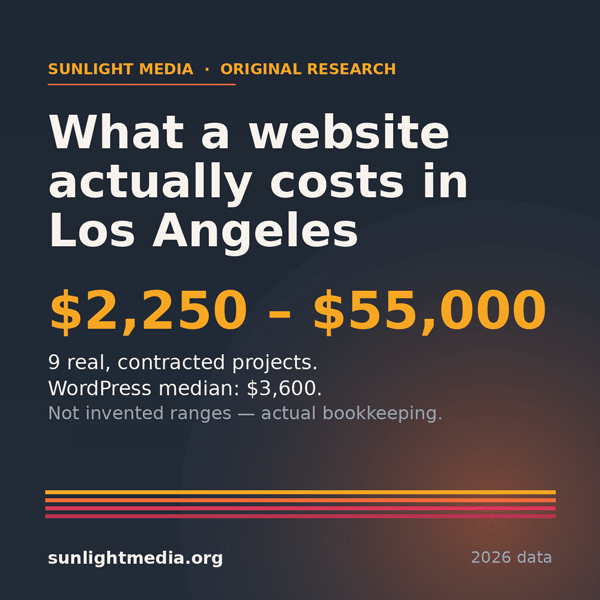
The short version: our contracted WordPress builds ran from $2,250 to $16,000, with a median of $3,600 and an average of $6,244. A custom web application — a different product entirely — came in at $55,000. The rest of this post explains what separates a $2,500 site from a $16,000 one, and why that $55,000 number is not part of the same conversation.
How we built these numbers
Transparency about method is the whole point of original research, so here is exactly what this is and is not:
- Source: Real, contracted website projects from a single Los Angeles agency — not estimates, not hypotheticals, not competitor surveys.
- Time period: Projects dated mid-2025 through early 2026.
- Sample: Eight WordPress builds form the core benchmark. One custom Laravel web application is reported separately because blending it into a WordPress median would distort both.
- Anonymization: Each project is labeled by industry only. No client names, URLs, logos, or identifying scope language.
- Prices shown are contracted prices. Where a repeat client received a loyalty discount, the discounted figure is the one recorded — because that is what was actually paid, and the discount itself is a pattern worth seeing rather than hiding.
- What is excluded: Ongoing maintenance retainers and hosting are not “build cost” and are reported separately, not mixed into the project figures.
After fifteen years of running this agency, I’ve watched the “request a quote” black box do more damage to clients than almost anything else in this industry. When nobody publishes real numbers, every business owner walks into every conversation blind, with no way to tell a fair price from an inflated one — and plenty of agencies prefer it that way. I’d rather lose a deal because someone saw our real range and chose differently than win one because they had nothing to compare it to. So these are our actual contracted prices, the messy spread and all, because a client who knows what things cost makes better decisions, and I’ve never lost sleep over an informed client walking away.
— Angelo Frisina, Founder, Sunlight Media
WordPress website pricing benchmark
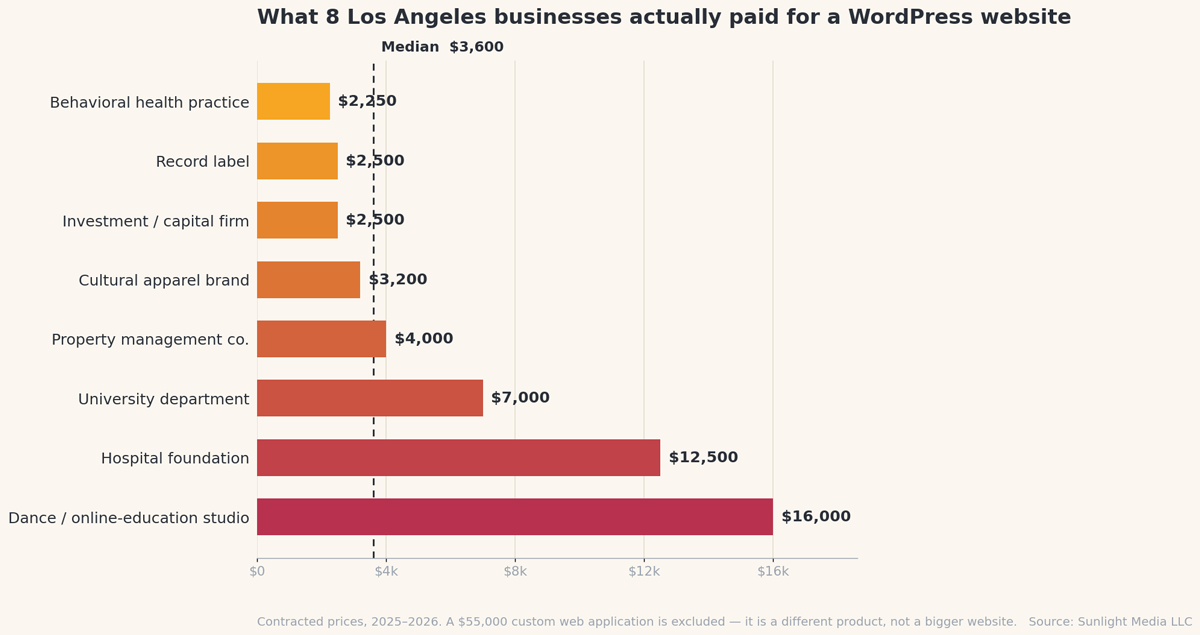
These are the eight WordPress projects, smallest to largest, with the scope that justified each price.
Behavioral health practice — $2,250 (2026)
~5 pages, custom WordPress build, Gutenberg content management, secure contact form. Repeat client, 10% loyalty discount applied.
Record label — $2,500 (2026)
~5 pages, custom theme, artist/producer roster content system, spam-protected contact form.
Investment / capital firm — $3,000 (2026)
~5 pages, custom theme, compliance/disclosure page, inquiry and contact forms.
Cultural apparel brand — $3,200 (2026)
Small site, WooCommerce setup, custom collections content system, on-site audio player, QR-code setup.
Property management company — $4,000 (2025)
Multi-property site, logo design (8 concepts), rental application form, online rent-payment form (Stripe/Zelle), professional copywriting.
University department — $7,000 (2026)
Full redesign, ~18–20 unique page templates, structured directories for staff/communities/events/jobs, modular block editor.
Hospital foundation — $12,500 (2025)
Donation platform integration, animated impact counter, ADA-compliant build, analytics setup, baseline SEO.
Dance / online-education studio — $16,000 (2026)
WooCommerce and Stripe, gated online video course platform, in-studio class booking, event ticketing, user dashboards, AI chatbot, content migration.
What the spread actually shows:
- Range: $2,250 – $16,000
- Median: $3,600
- Average: $6,244 (pulled upward by the two largest projects — the median is the more honest “typical” number)
- The floor repeats. Three separate projects landed at $2,250–$2,500. That is not a coincidence or a starting offer — it is what a standard, custom-built ~5-page WordPress site for a small business genuinely costs in Los Angeles right now.
Here’s what fifteen years of quoting these projects taught me: industry barely matters to price — structure does. A record label, an investment firm, and a behavioral health practice look like completely different businesses, but to a developer they’re the same job: roughly five pages, a custom theme, a content system the owner can actually update, and a contact form that doesn’t get spammed. That bundle has a real floor of work behind it — design, build, responsive testing, launch — and that floor doesn’t get cheaper just because the client is small or the industry is simple. The reason all three landed near $2,500 isn’t a price list; it’s that the underlying unit of work was identical, and there’s a point below which that work can’t be done properly no matter who’s asking. When someone quotes you $700 for “the same thing,” they’re not being generous — they’re not doing the same work.
— Angelo Frisina, Founder, Sunlight Media
A custom web application is a different product
One project in this set was contracted at $55,000. It belongs in its own category, and understanding why is the key to reading every other number on this page correctly.
Custom web application — $55,000 (~4.5 months)
Not WordPress. A custom-framework build with three permissioned user roles, a dynamic multi-step application workflow, digital signatures, integrated payments, accounting-system sync, CRM sync, an AI assistant, applicant dashboards, and an internal messaging system.
This is not a website with extra pages. It is bespoke software that happens to have a web interface. A WordPress site assembles and customizes a mature content platform; an application like this is built from the framework up to do something no off-the-shelf system does. Comparing its price to a brochure site is like comparing the cost of a storefront lease to the cost of building a factory — both involve a building, and that is where the similarity ends.
When someone can’t tell whether they need a $4,000 site or a $55,000 application, I ask one question: does your website need to show people things, or does it need to do things for them? A site that shows — your services, your team, your work, a form that lands in your inbox — is WordPress, and it’s the lower number. The moment people have to log in, see different things depending on who they are, and complete real transactions or workflows on the site, you’ve stopped describing a website and started describing software — and software is the bigger number, every time.
— Angelo Frisina, Founder, Sunlight Media
What you’ll pay to keep it running
Build price is not total cost of ownership, and any article that ignores the ongoing side is misleading by omission. Across these engagements, the recurring costs clients actually carried looked like this:
- Managed WordPress hosting: from roughly $24/month
- Maintenance, pay-as-you-go: $85/hour, no commitment
- Quarterly maintenance plan: ~15 hours over 90 days for $1,125
- Monthly maintenance plans: 20 hours/month at $1,600, or 40 hours/month at $3,000
- Third-party services some sites require: donation platforms, video hosting, or AI chatbot subscriptions — typically $12–$40/month each, paid by the site owner directly
A $3,000 WordPress site with $24/month hosting and occasional pay-as-you-go support is a very different long-term commitment than a site that depends on three paid subscriptions and a monthly retainer. Both are legitimate; the difference should be a decision, not a surprise.
What actually drives the price
Looking across all eight WordPress projects, the price was never really about “how nice it looks.” Six concrete factors moved the number, and the dataset shows each one clearly.
1. Page and template count
The clearest single lever. The ~$2,500 floor consistently bought roughly five pages on a custom theme. The university department’s $7,000 bought a full redesign with 18–20 unique templates and structured directories. Same platform, nearly triple the price — almost entirely a function of how many distinct page types had to be designed and built.
2. What the forms do
A contact form that emails the owner is effectively free — it ships with the floor price. A form that takes a rent payment, processes a donation, or runs a multi-step application is a different animal. The property management company’s rent-payment form (with two payment methods and a transaction-fee rule) is a large part of why that project was $4,000 rather than $2,500.
3. The platform itself
There is a visible cliff here. A custom WordPress theme tops out around $7,000 in this data. Add a full e-commerce and course platform and you are at $16,000. Move off WordPress entirely to a custom-framework application and you are at $55,000. Platform choice is the largest non-linear cost multiplier in the entire set.
4. Third-party integrations
Every integration is a contract with someone else’s software. Payment processing, a donation system, an accounting sync, a CRM sync, an AI assistant — each one adds development, testing, and failure points. The projects with the most integrations are, predictably, the most expensive ones.
5. User roles and dashboards
A site one administrator updates is cheap. A site where different people log in, see different things, and perform different actions — students, staff, applicants, coordinators — is expensive. The jump from “the owner edits pages” to “multiple user types with separate permissions and dashboards” is the conceptual line between the WordPress tier and the application tier.
6. Bundled extras
Logo design, professional copywriting, content migration, and “wow” features like an animated impact counter are real line items. They are easy to overlook when comparing quotes and they account for meaningful differences between two sites that otherwise look similar in scope.
After quoting hundreds of these, here’s the gap between what clients think drives cost and what actually does. Almost everyone walks in worried about design — how many mockups, how many revisions, how custom the look is. Design is real work, but it’s the most predictable line item I have; it rarely moves a quote much. The two things that genuinely move the number are the ones nobody asks about: what your forms have to do, and how many different kinds of people log in. A contact form that emails you is essentially free. A form that takes a payment, runs a multi-step application, and emails three people conditionally is a different project wearing the same word “form” — and that single distinction is the difference between our $2,500 sites and our $4,000-plus ones. The same is true for logins: one admin editing pages is cheap; students, staff, and applicants each seeing different things is the line where a website quietly becomes software. If you want to predict what your project will cost, stop counting pages and start counting verbs.
— Angelo Frisina, Founder, Sunlight Media
How this compares to Wix, Squarespace, Fiverr, and budget freelancers
It would be easy to use this data to dismiss the cheap options. That would also be dishonest, so here is the fair version.
The case for the low-cost route is real. A Wix or Squarespace DIY site, a $500 freelancer, or a $50 Fiverr template can be the correct choice if you are pre-revenue, validating an idea, need something live this week, or genuinely have no budget. A working basic site beats no site, and paying $3,000 for a presence you could have proven with a $200 template is a bad use of money for a brand-new venture.
What the $2,250–$4,000 tier buys that the cheap routes do not is ownership and control: a site you fully own with no platform lock-in, a content structure built around your actual business rather than a template’s assumptions, forms that do real work, and a person who answers when something breaks. The DIY platforms rent you a system; this tier builds you an asset. For an established business where the website generates leads or revenue, that distinction usually pays for itself; for a hobby or a test, it usually does not.
I’ve told people they cant afford us more times than I can count, and it’s never once been the wrong call. If you’re pre-revenue, testing whether an idea even has legs, or you genuinely can’t absorb a few thousand dollars right now — build it yourself on Squarespace and come back when the business is real. I’d rather you spend $200 proving the concept than $4,000 polishing something you might walk away from in six months. The clients who come back after that Squarespace year are some of the best we’ve ever had, because by then they know exactly what they need and why it’s worth paying for.
— Angelo Frisina, Founder, Sunlight Media
What you get at each price tier
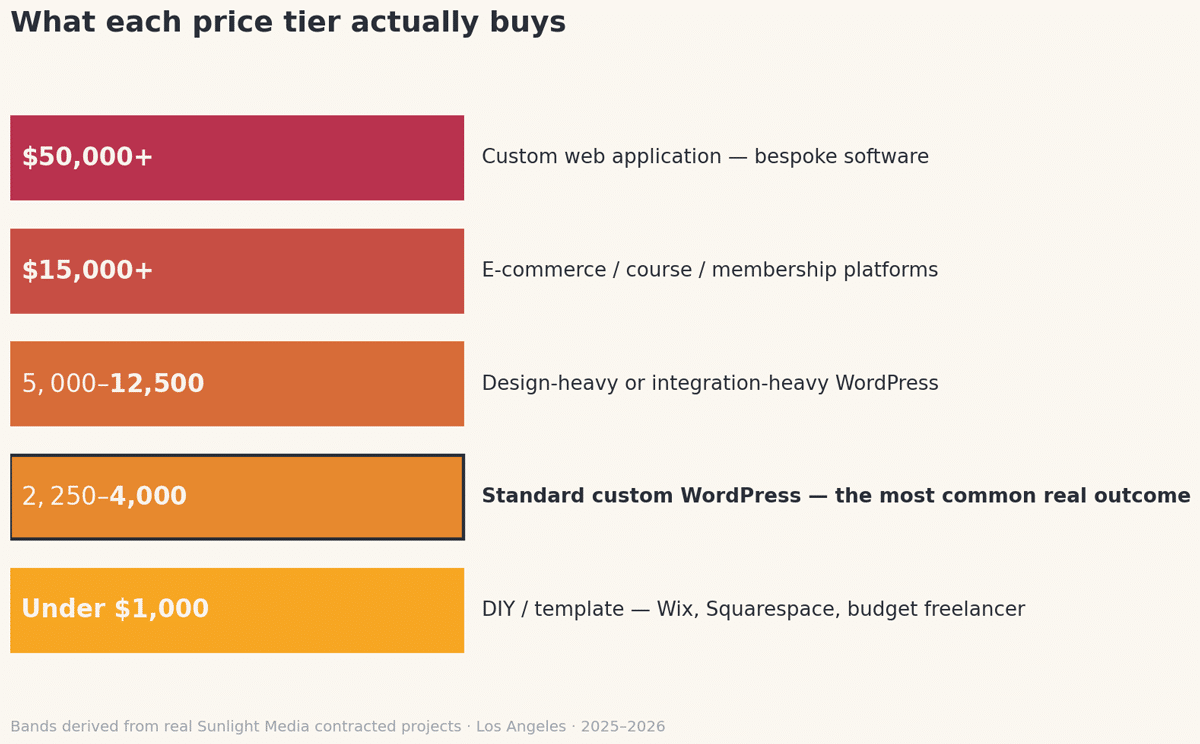
Translating the data into plain bands a business owner can actually use:
- Under $1,000 — DIY / template. Wix, Squarespace, a budget freelancer. You operate it; you do not own the underlying system. Right for very early or no-budget situations.
- $2,250–$4,000 — standard custom small-business WordPress. ~5 pages, custom theme, real forms, you own everything. The most common real outcome in this dataset. Right for most established local businesses.
- $5,000–$12,500 — design-heavy or integration-heavy WordPress. Large template counts, redesigns, structured directories, donation or analytics integrations, ADA work. Right for organizations where the site does real operational work.
- $15,000+ — e-commerce / membership / course platforms. WooCommerce, gated content, booking, ticketing, user dashboards. Right when the site is the business, not a brochure for it.
- $50,000+ — custom web application. Bespoke software, multiple user roles, deep integrations. A different product with a different procurement conversation entirely.
The bottom line
If you run an established business in Los Angeles and you want a custom-built, fully owned WordPress website, the realistic number in 2026 is around $2,250 to $4,000 for a standard small-business site, scaling to $7,000–$16,000 as page count, integrations, and user functionality grow. Custom applications are a separate category that starts around $50,000. Anyone quoting you a single round number without asking how many page types you need, what your forms have to do, and who logs in is guessing — and now you have the real distribution to check their guess against.
Whoever you talk to, use these numbers the same way: ask them to tell you which tier your project sits in and why, and if the answer is a single round figure with no questions about your pages, forms, or who logs in, you’re being guessed at — push back. If you’d like a second set of eyes on a scope or a quote you’ve already received, ours or anyone’s, start a conversation here — no pitch, just an honest read.
This benchmark is drawn from contracted Sunlight Media projects and reflects the Los Angeles market in 2025–2026. Pricing for your specific project depends on scope.